
Tuckpointing in Morton Grove, IL
Morton Grove grew fast in one narrow window. The village went from around 3,900 people in 1950 to more than 20,500 by 1960, and that boom left behind a housing stock where 63.8% of homes were built between 1940 and 1969, the largest single-era share of any village we serve. Most of that stock is brick ranch and split-level construction, and with 73.9% of Morton Grove homes single-family detached, the highest share of the three suburbs we cover, there is a lot of exterior brick wall out there that has been through decades of freeze-thaw cycling.
A homeowner-heavy market
Morton Grove has the highest owner-occupancy rate of the three villages we serve, at 85.2%. That tends to mean owners who plan to stay put and treat exterior masonry as a long-term investment rather than a quick pre-sale patch. We approach Morton Grove jobs the same way: a repair that protects the wall for years, not a cosmetic fix that looks fine until the next winter.
Licensed and bonded, by village rule
Morton Grove doesn't leave contractor qualifications to chance. Aside from landscapers and painters, every contractor working in the village needs a village business license backed by liability insurance and a $10,000 surety bond, and the mason has to be named directly on any building permit application that requires one. That bar applies on every job here, no exceptions, and it's worth confirming with any masonry contractor you're considering in Morton Grove. How the neighboring villages compare is in our permit guide.
What tuckpointing costs in Morton Grove
Spot repairs on isolated joints run $50 to $500. A full-wall tuckpointing job runs $12 to $25 per square foot, putting a typical 500-square-foot wall between $6,000 and $12,500, and with Morton Grove's median home size at 5.9 rooms, many jobs here run a full exterior rather than a single wall. Chimney tuckpointing runs $500 to $2,500 for a standard repair, more for a full rebuild. Masonry labor in the region typically runs $50 to $100 an hour, already reflected in those per-square-foot figures, and because mortar needs temperatures roughly between 40 and 90 degrees to set properly, the practical scheduling window runs from about April through October. Full details on how we scope and quote a job are on our tuckpointing page, and on chimney repair specifically for flue and crown work.
Dempster Street and the village's growing civic core
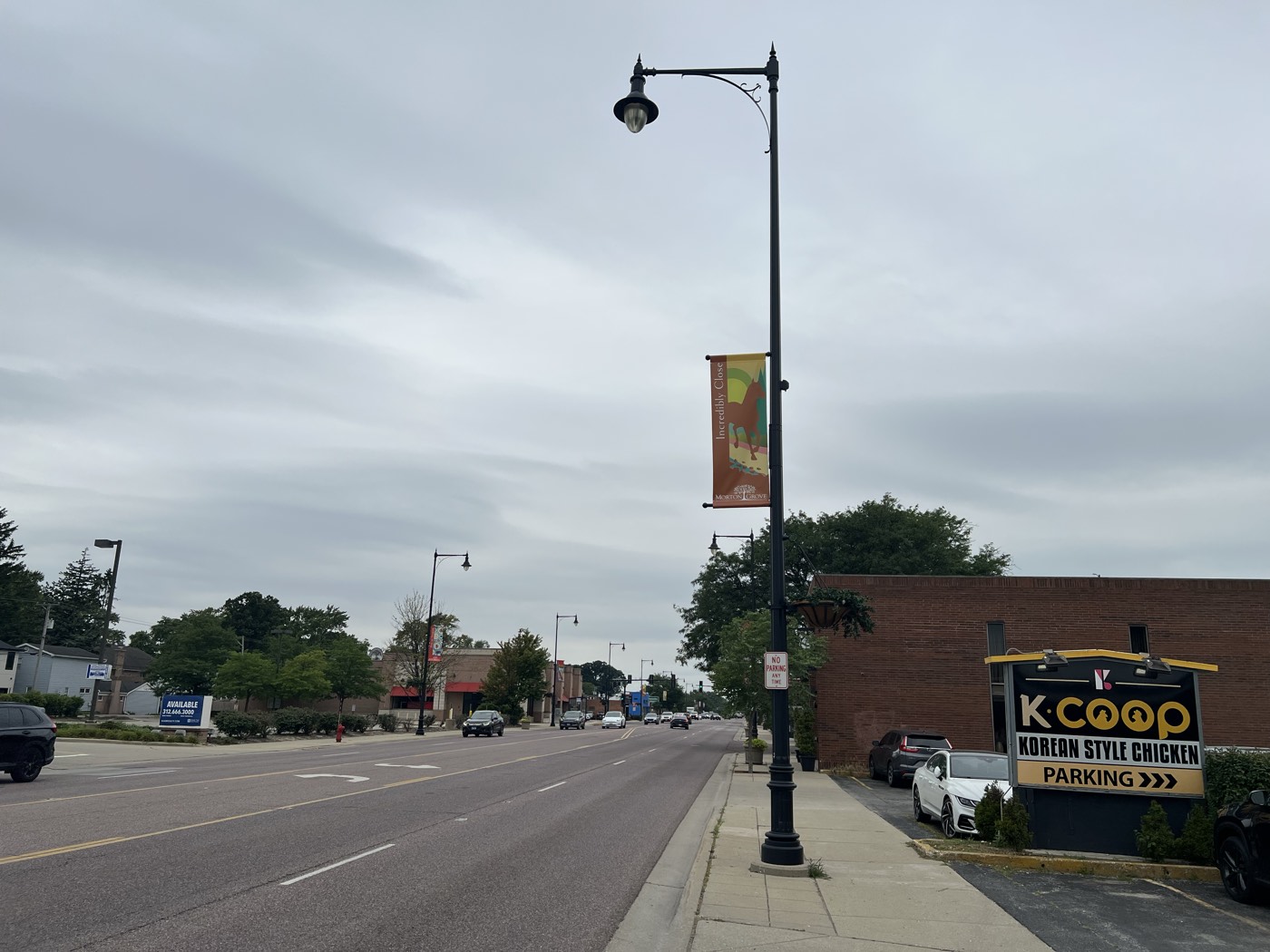
Morton Grove has been putting real investment into Dempster Street, the village's main commercial spine, as part of an active redevelopment plan centered on Harrer Park and the surrounding civic buildings. The village itself formally incorporated on December 24, 1895, so the brick along Dempster spans a much longer stretch of history than the postwar boom alone. Exterior masonry matters more in a village paying that kind of attention to its own street frontage, and it's part of why we treat Morton Grove exteriors as a long-term asset rather than a one-time fix.
Lintels on 1950s-60s brick
Steel window and door lintels from Morton Grove's postwar building boom rust from the inside out, and the expansion that follows is a common source of the diagonal brick cracking we get called about on ranches and split-levels from that era. When that's the cause, we cover lintel replacement options rather than repointing over it.
Nearby areas
We also serve Lincolnwood and Niles, both a short drive along Dempster and Touhy.
Get a firm Morton Grove tuckpointing quote.
Call (224) 347-9439Morton Grove tuckpointing questions
Do you meet Morton Grove's licensing rules for masons?
Yes. Morton Grove requires every contractor working in the village, other than landscapers and painters, to carry a village contractor's business license backed by liability insurance and a $10,000 surety bond, and the Village's own building permit application lists "Mason" as a distinct required contractor line for permitted projects. That standard is non-negotiable on every Morton Grove job, no exceptions.
Do I need a permit for basic tuckpointing?
Routine tuckpointing is generally not a separately permitted item in Morton Grove. If your project grows into a chimney rebuild or other structural masonry work routed through a standard building permit, the licensed mason has to be named on that application, and we handle that paperwork with the Department of Buildings at 6101 Capulina Avenue.
My split-level or ranch is from the 1950s-60s boom. How urgent is repointing?
Worth a look. Nearly 64% of Morton Grove homes were built between 1940 and 1969, the largest single-era concentration of any village we serve, during the village's population boom from about 3,900 residents in 1950 to over 20,500 by 1960. Brick and mortar from that wave has had six-plus decades of Chicago winters to work on it, and with 73.9% of Morton Grove homes single-family detached, most of that brick is exterior wall carrying real weather exposure.
Request a free Morton Grove quote
Or contact us directly.